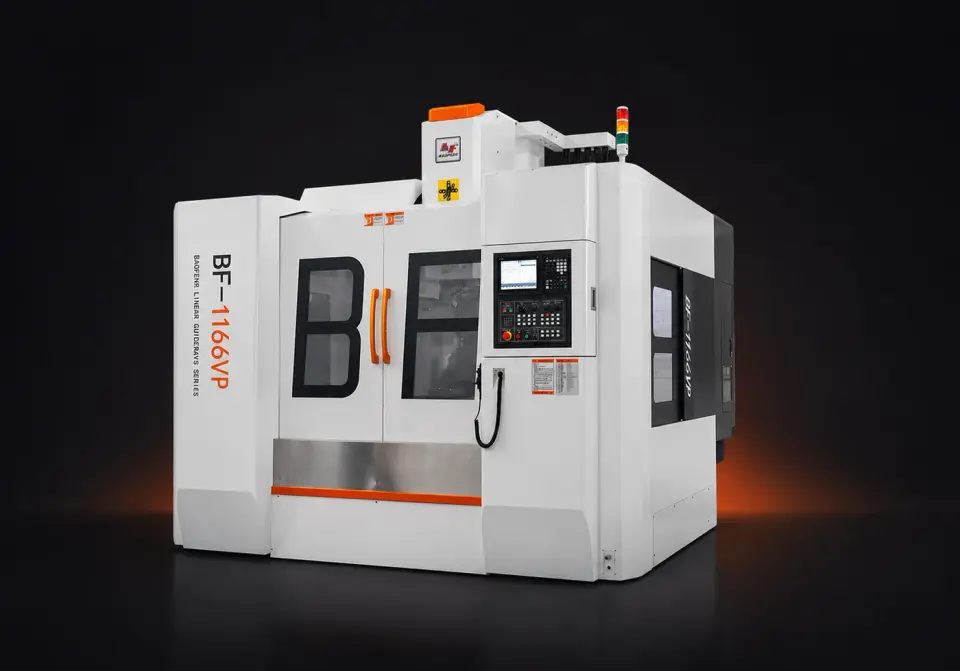
How to choose a CNC machining centre
The complete guide
Thinking of investing in a machining centre? This guide covers the 7 key criteria for making the right choice — without unnecessary jargon.
Guideway type: linear or box-way?
This is the first question to ask. The guideway type determines the fundamental behaviour of your machine.
Linear guideways
- High rapid traverse rates (36 to 48 m/min)
- Fast acceleration
- Ideal for aluminium and light alloys
- Medium to large production runs
- Shorter cycle times
Box-way guideways
- Superior rigidity and damping
- Vibration absorption in heavy-duty machining
- Ideal for steel, cast iron and hard materials
- Accuracy maintained over the long term
- Service life of at least 20 years
Our advice: if you mainly machine aluminium in medium batches, linear guideways are ideal. If you work with steel, cast iron or moulds, go for box-way. At Baofeng, the V Series uses linear guideways and the VP Series is box-way.
The spindle: the heart of the machine
The spindle determines what you can cut, how fast, and with what surface finish.
Rotational speed: 8,000 rpm is enough for standard steel. 10,000 to 12,000 rpm for aluminium. 15,000 to 18,000 rpm for high-speed finishing and small tools.
Torque or speed: high torque at low rpm is critical for heavy machining (steel, cast iron). High speed is critical for aluminium finishing.
Tool holder type: BT40 is the most widespread standard. BT50 for heavier machines. HSK-A63 for 5-axis and high-speed work (better balancing, better radial rigidity).
Our advice: don't choose an oversized spindle “just in case”. A 12,000 rpm BT40 spindle covers 90 % of general engineering needs. All our machines are fitted with Fanuc or Siemens spindles.
Travels and working envelope
The X, Y and Z travels determine the maximum part size you can machine. But be careful: just because the X travel is 1,300 mm doesn't mean you can machine a 1,300 mm part — you need to allow for clamping and tool access.
Rule of thumb: take the largest part you will regularly machine and add a 20 % margin: that is the minimum travel you need.
| Typical parts | Min. travels | Baofeng series |
|---|---|---|
| Small parts (< 300 mm) | 600 × 400 mm | V Series (V8) |
| Medium parts (300 to 800 mm) | 1 000 × 600 mm | V Series (1166V) |
| Large parts (800 to 1,500 mm) | 1 300 × 700 mm | VP Series (1370VP) |
| Very large parts (> 1,500 mm) | 2 500+ mm | DC Series |
The CNC control
The CNC is the brain of your machine. In France, three brands dominate the market:
Fanuc
The most widespread. Reliable, simple, universal. Trained operators are easy to find. Standard on most Baofeng machines.
Siemens
Very popular in Europe. SINUMERIK ONE is the latest generation — powerful for 5-axis work. Available on our A and DC Series.
Heidenhain
Favoured by mouldmakers. Excellent for finishing complex surfaces. Available as an option on the BF-500A5, 630A5 and 800A5 5-axis machines.
Our advice: if your operators know Fanuc, stick with Fanuc. It's the most pragmatic choice. If you are investing in 5-axis, Siemens SINUMERIK is an excellent choice. Fanuc vs Siemens comparison →
The tool changer
The number of pockets and the tool change speed have a direct impact on your cycle times.
24 tools are enough for 80 % of general engineering applications. 32 to 40 tools for complex multi-operation parts. Tool change time ranges from 1.3 seconds (T Series) to 4 to 5 seconds (double-column).
Productivity options
The options that make a difference day to day:
- 4th axis
- Indexing table to machine several faces without unclamping. Immediate return on investment in subcontracting.
- Part probe
- Renishaw OMP60 — automatic datum setting, fewer rejects.
- Tool probe
- Renishaw TS27 — automatic length and diameter measurement, breakage detection.
- Through-spindle coolant
- 20 to 70 bar depending on the model. Essential for deep drilling and stainless steel.
- Chip conveyor
- Continuous chip removal. Essential in series production to avoid stoppages.
After-sales service and support: the forgotten criterion
This is probably the most important criterion — and the most overlooked. A machine standing idle can cost several thousand euros a day in lost production.
Before buying, ask these questions:
- Does the distributor hold a stock of spare parts in France ?
- What is the guaranteed response time?
- Who carries out the maintenance — the distributor, or a subcontractor you don't know?
- Is operator training included or charged extra?
- What is the actual warranty period (not the marketing one)?
At MainJobToDo: spare parts stocked in France, immediate 24/7 technical assistance and fast on-site intervention, training included, 1-year warranty, and a single point of contact from start to finish. Find out more →
Keep this guide to hand
Save it as a PDF or print it to share with your team: the full guide, without the menu or forms.
In the print window, choose “Save as PDF”.
Use our configurator to find your machine
4 questions, 2 minutes, a personalised recommendation.