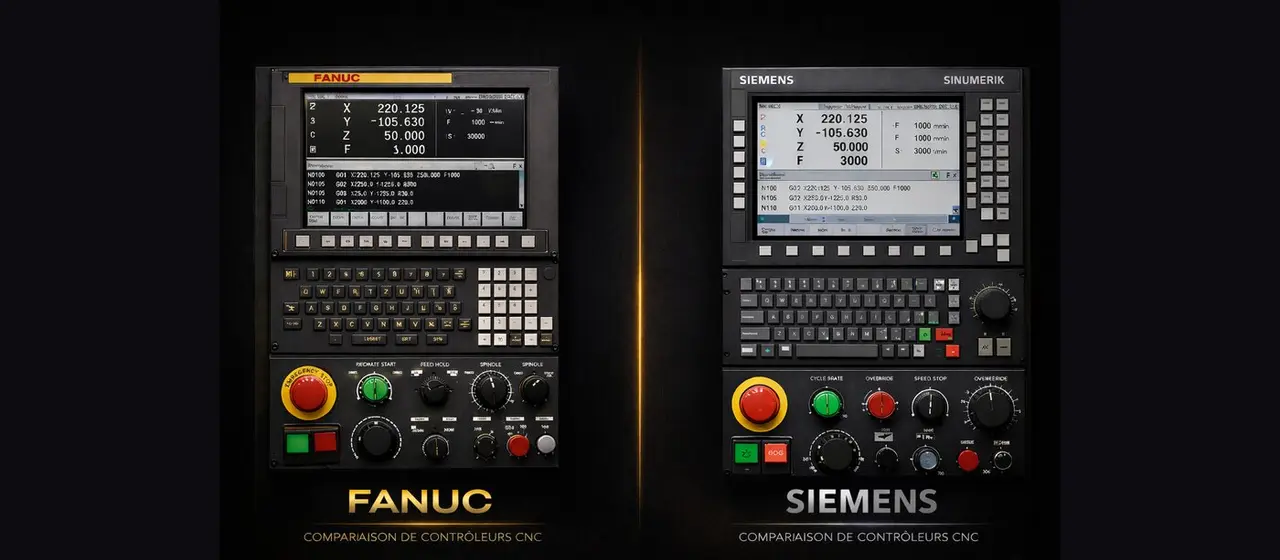
In France, two CNC control brands dominate the CNC milling market: Fanuc and Siemens. Together, they equip more than 95% of the installed base of machining centres in Europe. The choice between them is not about quality — both are excellent — but about your workshop context: your operators, your types of machining, your software integration and your budget.
Fanuc 0i-MF Plus: the universal benchmark
Fanuc is the most widely installed CNC control in the world. In France, around 65% of machining centres are fitted with Fanuc. This dominance comes down to three factors: simplicity, reliability and cost.
Strengths
- Ease of use: the Fanuc interface has a “no-nonsense” reputation. An experienced operator can switch machines and find their bearings within a few hours. Menus are logical and standard G-codes are followed to the letter.
- Available workforce: this is the clinching argument in France. Most training centres (AFPA, Greta, technical colleges) train on Fanuc. Recruiting a Fanuc operator is significantly easier than finding a Siemens operator.
- Legendary reliability: Fanuc CNC controls have one of the lowest failure rates in the industry. The worldwide after-sales service is well organised, with parts available quickly.
- Lower cost: for an equivalent configuration, a Fanuc CNC control costs €3,000 to €8,000 less than a Siemens SINUMERIK ONE. On a €120,000 machine, that is a significant difference.
- Pure ISO programs: excellent with traditional G-code, compatible with every CAM post-processor on the market without adjustment.
Limitations
- Simultaneous 5-axis: possible but less smooth than Siemens. RTCP (Rotation Tool Center Point) works but requires more parameter setting.
- Graphical interface: plainer than Siemens. No native conversational programming as advanced as ShopMill.
- Digital twin: no native equivalent to the Siemens digital twin.
Siemens SINUMERIK ONE: power and integration
Siemens SINUMERIK ONE is the latest generation of Siemens CNC control, succeeding the SINUMERIK 840D sl. Widely used in Germany, Switzerland and Northern Europe, it is gaining ground in France, particularly in workshops doing 5-axis work.
Strengths
- Native simultaneous 5-axis: kinematics management has always been Siemens’ strong point. TRAORI (Transformation Orientation) provides smooth, precise control of 5-axis movements, with automatic compensation for kinematic errors.
- ShopMill: powerful conversational programming. An operator can program simple to moderately complex parts directly on the machine, without going through CAM. A considerable time saving for one-off parts and prototypes.
- Advanced CAM integration: native link with Siemens NX, excellent with Mastercam, Hypermill and most premium CAM software. Advanced technology cycles can be called directly.
- Digital twin (Run MyVirtual Machine): full simulation of the machine on a PC before machining. Lets you validate programs, detect collisions and optimise toolpaths without tying up the machine.
- Native 22" touchscreen: modern, customisable interface with smooth navigation.
- Built-in measuring cycles: Siemens cycles for Renishaw probes are directly integrated and simpler to set up.
Limitations
- Higher cost: €3,000 to €8,000 more than a Fanuc, depending on the options enabled.
- Learning curve: an operator used to Fanuc will need 2 to 4 weeks to become fully productive on Siemens. The reverse is also true, but as the Fanuc installed base is larger, it is more often this way round.
- Harder recruitment: fewer operators trained on Siemens in France, especially outside large industrial groups.
Summary comparison
| Criterion | Fanuc 0i-MF Plus | Siemens SINUMERIK ONE |
|---|---|---|
| Market share in France | ~65 % | ~30 % |
| Learning curve | Quick (a few hours) | 2-4 weeks to adapt |
| Shop-floor programming | Standard G-code, Manual Guide i | ShopMill conversational |
| Simultaneous 5-axis | Functional (RTCP) | Excellent (native TRAORI) |
| CAM integration | Good (all post-processors) | Excellent (native NX, advanced cycles) |
| Digital twin | Not native | Run MyVirtual Machine |
| Screen | 15" touchscreen | 22" touchscreen |
| Operator recruitment | Easy in France | More difficult |
| Average extra cost | Baseline | +3 000 à +8 000 € |
| Ideal use case | 3-axis, 3+2, series production | Simultaneous 5-axis, prototyping, advanced CAM |
How to choose: 5 decisive questions
Answer these five questions to decide:
- Which CNC control are your operators trained on? If Fanuc → stick with Fanuc, unless you absolutely need simultaneous 5-axis. The cost of training an operator far exceeds the price difference between the controls.
- Do you do simultaneous 5-axis work? If so (not 3+2, but true continuous 5-axis) → Siemens has a real advantage in smoothness and programming.
- Do you program at the machine? If your operators create programs directly on the control → ShopMill (Siemens) is more powerful than Manual Guide i (Fanuc) for conversational programming.
- Which CAM software do you use? If Siemens NX → SINUMERIK ONE is the natural choice (native integration). For any other software (Mastercam, TopSolid, Esprit, etc.), both controls work well.
- What is your budget? If the €5,000-8,000 difference is critical to your financing plan, Fanuc remains the rational choice with no compromise on machining quality.
Our position at Baofeng
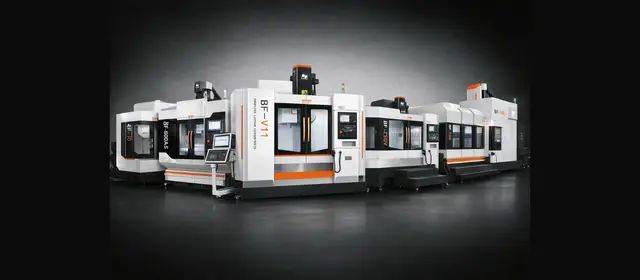
All our machines — from the T Series drilling-tapping centres to the DC double-column machines and the A Series 5-axis machines — are available with Fanuc or Siemens. The choice is made at order and we install both with the same level of care.
Our general recommendation for the French market:
- General engineering workshops, subcontracting, small batches → Fanuc (simplicity, cost, recruitment)
- Specialist 5-axis shop, high-end moulds, aerospace → Siemens (kinematic power, ShopMill, digital twin)
- Industrial group with several machines → standardise on the same CNC control to simplify training and operator interchangeability
Need help deciding?
Our technical advisers know both CNC controls in detail and can guide you based on your specific workshop. Request a call back or use our configurator, which factors the choice of CNC control into its recommendations.