Buying a CNC machining centre is an investment of €80,000 to €400,000 depending on size and options. At that level, a poor choice cannot be undone: an undersized machine holds back your production, an oversized one drains your cash flow. Here are the 7 criteria to analyse methodically before you sign.
1. Guideway type: linear or box-way?
This is the most fundamental choice. The guideways determine the machine's core behaviour.
- Linear rail guideways (THK or Hiwin type): rapid traverse up to 48 m/min, high acceleration, ideal for aluminium, varied small batches and fast cycles. This is the standard on our V Series.
- Box-way guideways (Turcite-coated slideways): superior vibration damping, maximum rigidity in heavy cutting, perfect for steel, cast iron and titanium. This is the speciality of our VP Series.
Rule of thumb from the shop floor: if more than 60% of your production is in hard materials (steel > 45 HRC, stainless steel, titanium), box-way is a must. For everything else, linear guideways are more versatile and faster.
→ Our detailed comparison of linear vs box-way guideways
2. The spindle: speed, torque and tool interface
The spindle is the productive heart of the machine. Three key parameters:
| Type of work | Required speed | Torque |
|---|---|---|
| Steel / cast iron roughing | 6,000 – 10,000 rpm | High (> 150 Nm) |
| Aluminium machining | 12,000 – 15,000 rpm | Medium |
| High-speed finishing | 15,000 – 24,000 rpm | Low (speed is the priority) |
| Moulds & tooling | 12,000 – 18,000 rpm | High to medium |
Tool interface: BT40 covers 90% of general milling needs. For heavy roughing or heavy parts, move up to BT50 (available on our DC Series double-column machines). HSK is recommended for high-speed and 5-axis work (A Series).
Watch out: don't look only at maximum speed. An operator machining steel 80% of the time will never use a 24,000 rpm spindle to its full potential. Conversely, an 8,000 rpm spindle on aluminium produces poor surface finishes and long cycle times.
3. X, Y, Z travel: size it right
The basic rule: take your largest recurring part and add 20%. This margin covers workholding, tool clearance and future needs.
Our ranges cover a wide spectrum:
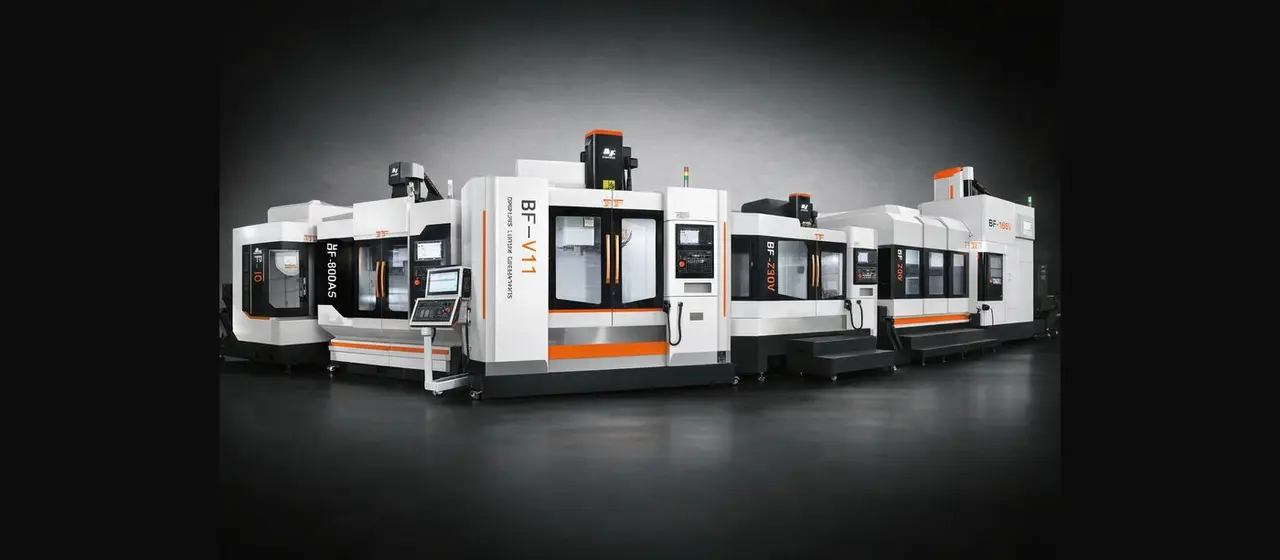
- Compact (800 × 500 mm): V8 — small to medium-sized parts
- Standard (1,100 × 600 mm): V11 — the best-seller, suits most workshops
- Large format (2,000 × 1,600 mm and above): DC Series double-column — aerospace, moulds, structural parts
Common pitfall: buying too big “just in case”. An oversized machine takes up more space, uses more energy and has longer positioning times. Two well-sized machines are better than one that is too big.
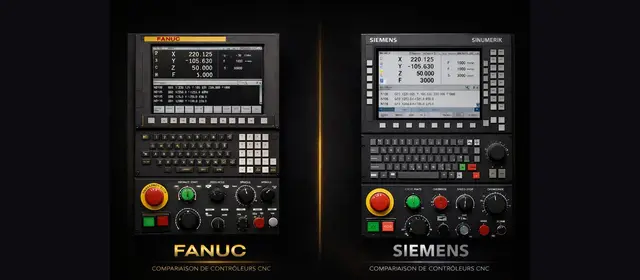
4. CNC control: Fanuc or Siemens?
In France, two brands dominate: Fanuc (around 65% of the installed base) and Siemens SINUMERIK (around 30%). The choice depends on your workshop, not on the machine.
- Fanuc 0i-MF Plus: simple interface, most French operators are trained on it, worldwide after-sales service, lower cost. Ideal for 3-axis and 3+2-axis work.
- Siemens SINUMERIK ONE: powerful in simultaneous 5-axis, excellent CAM integration, ShopMill for conversational programming, built-in digital twin.
→ Our full Fanuc vs Siemens comparison
All our machines are available with Fanuc or Siemens. The choice is made before ordering and cannot be changed afterwards.
5. Tool changer: capacity and speed
The tool changer has a direct impact on your cycle times, especially in small batches where tool changes are frequent.
- 24 tools: covers 80% of general engineering needs
- 32 to 48 tools: recommended for shops working with several materials or in moulds & tooling
- 60+ tools: essential for automated cells or medical work
Change time: our machines deliver tool-to-tool changes in 1.5 to 2.8 seconds depending on the model. On a run of 100 parts with 8 tools per part, the difference between a 1.5s and a 4s change adds up to 33 minutes saved per batch.
6. Productivity options: measure the ROI
Every option should be justified by a concrete return on investment:
- 4th axis (rotary table): machining of multi-face parts in a single clamping. Typical ROI: 6-12 months for a subcontracting shop.
- Renishaw tool probe: automatic length and diameter measurement, breakage detection. Eliminates human gauging errors.
- Part probe: automatic datum setting, in-process inspection. Essential for tight-tolerance parts (< 0.02 mm).
- Through-spindle coolant: chip evacuation in deep drilling, cooling of the cutting edge. Practically mandatory for stainless steel and titanium.
- Chip conveyor: automates chip removal, reduces machine stoppages and protects the guideways.
7. After-sales service and technical support: the most overlooked criterion
Paradoxically, this is the most important criterion for long-term profitability. A machine standing idle is a machine that costs money instead of producing.
What to check before buying:
- Does the distributor hold a stock of spare parts in France? (Not in China with a 6-week lead time)
- What is the guaranteed response time? (At MainJobToDo: on-site within 48h in mainland France)
- Is initial training included? (Ours: 2 days on site at installation)
- Is there responsive telephone support? (Our technical team replies within 2h on working days)
- What is the warranty? (Our warranty: 2 years parts and labour)
A reputable distributor will readily give you verifiable customer references. Ask for them.
Ready to move forward?
Use our online configurator to identify the models suited to your production in 2 minutes. Or contact our technical team directly — we reply within 24h with a tailored recommendation.