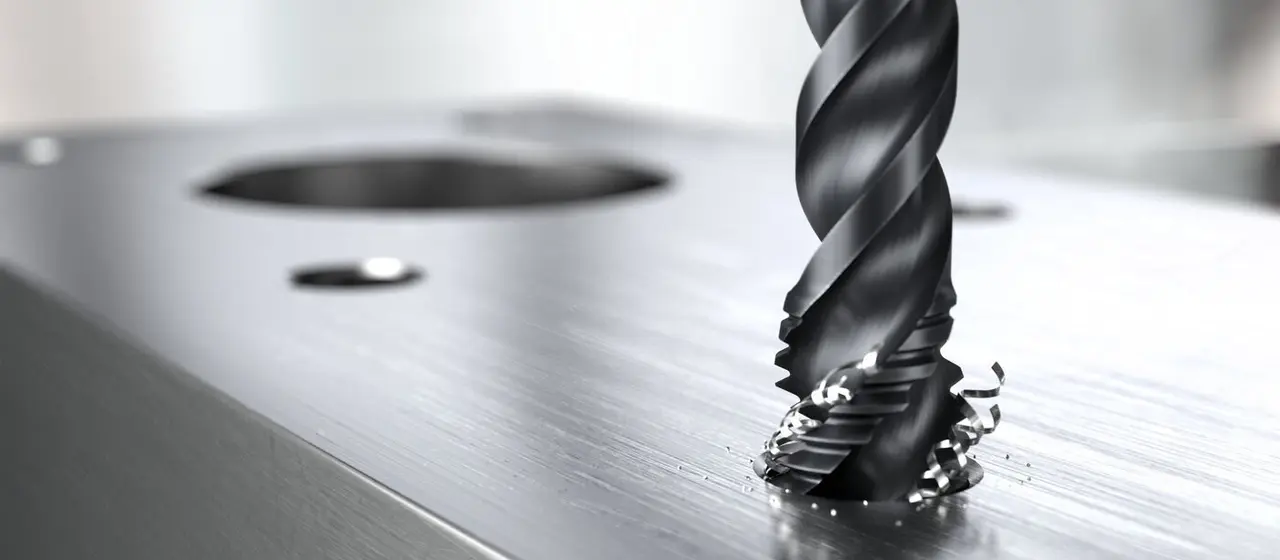
Drilling before tapping is a critical machining step: a pilot hole that is too small breaks the tap (a major risk on an expensive part), while one that is too large produces an incomplete thread and poorer mechanical strength. The ISO standard recommends 75% thread engagement, the optimum compromise between thread strength and tapping torque. Beyond that, torque rises exponentially with no significant gain in strength; below it, the permissible load drops rapidly.
The drill chart below applies to ISO 261 (coarse pitch) and ISO 262 (fine pitch) metric threads. The calculator updates the results in real time for all common sizes from M2 to M30.
Complete reference table — M2 to M30
Values calculated for 75 % thread engagement, for both standard pitch (ISO 261 coarse) and fine pitch (ISO 262). The smallest threads (M2 – M3) are only available in standard pitch in the common series.
| Thread | Coarse pitch | Fine pitch | ||
|---|---|---|---|---|
| Pitch (mm) | Drill (mm) | Pitch (mm) | Drill (mm) | |
| M2 Std | 0,40 | 1,60 | — | — |
| M2,5 Std | 0,45 | 2,05 | — | — |
| M3 Std | 0,50 | 2,50 | — | — |
| M4 | 0,70 | 3,30 | 0,50 | 3,50 |
| M5 | 0,80 | 4,20 | 0,50 | 4,50 |
| M6 | 1,00 | 5,00 | 0,75 | 5,25 |
| M8 | 1,25 | 6,80 | 1,00 | 7,00 |
| M10 | 1,50 | 8,50 | 1,25 | 8,75 |
| M12 | 1,75 | 10,20 | 1,25 | 10,80 |
| M14 | 2,00 | 12,00 | 1,50 | 12,50 |
| M16 | 2,00 | 14,00 | 1,50 | 14,50 |
| M18 | 2,50 | 15,50 | 1,50 | 16,50 |
| M20 | 2,50 | 17,50 | 1,50 | 18,50 |
| M22 | 2,50 | 19,50 | 1,50 | 20,50 |
| M24 | 3,00 | 21,00 | 2,00 | 22,00 |
| M27 | 3,00 | 24,00 | 2,00 | 25,00 |
| M30 | 3,50 | 26,50 | 2,00 | 28,00 |
The calculation formula
The tap drill diameter depends on the nominal diameter, the pitch and the target engagement percentage. The simplified formula used in industry:
The factor 1,0825 corresponds to the height of the ISO thread triangle (H = P × √3 / 2) relative to the diameter. For 100 % engagement, this gives the theoretical minor diameter:
Example for M8 standard pitch (P = 1,25 mm): Ddrill = 8 − (1,25 × 75 / 100) × 1,0825 = 8 − 1,015 = 6,98 mm, rounded to 6,80 mm (nearest standard drill, rounded down).
Choosing the right engagement
Thread engagement is the percentage of the theoretical thread height actually formed. The choice depends on the material and the required strength:
à 70 %
à 85 %
Tapping speed and lubrication
Tapping speed is always much lower than drilling speed. Rule of thumb: 1/3 of the drilling speed for the same diameter in the same material. Carbide taps allow speeds 2 to 3 times higher than HSS taps, but require a rigid machining centre and synchronous tapping (Z axis slaved to spindle rotation).
Indicative speeds by material
- Mild steel: 8 to 15 m/min (HSS), 25 to 40 m/min (carbide).
- Medium-hard steel: 5 to 10 m/min (HSS), 15 to 30 m/min (carbide).
- Austenitic stainless steel: 3 to 6 m/min (HSS). High-pressure lubrication essential.
- Aluminium: 15 to 30 m/min (HSS), 40 to 80 m/min (carbide).
- Grey cast iron: 6 to 12 m/min (HSS). Dry tapping possible.
- Titanium: 2 to 5 m/min (HSS). Form tap recommended, EP lubricant.
Lubrication
Tapping generates high friction forces along the entire engaged length. Unsuitable lubrication causes galling, material tearing and tap breakage. A few rules:
- Sulphurised EP cutting oil (extreme pressure) for steels and stainless steels.
- Neat oil or rich emulsion (10 %) for aluminium — avoid lean emulsions, which stick to the tap.
- Synchronous tapping + through-spindle coolant for high throughput on a machining centre.
- Form tap (thread-forming tap) on ductile materials: no chips, stronger thread, tool life multiplied by 3 to 5. Note: the tap drill diameter is different (larger, approximately 97 % of the nominal diameter).
Cutting taps vs form taps
Two technologies coexist depending on the application:
- Cutting tap: chip removal, suitable for all materials. Chips must be evacuated (spiral or straight flutes depending on blind/through hole). Tap drill diameter calculated above.
- Form tap: plastic deformation of the material, without chips. Restricted to ductile materials (aluminium, mild steel, copper, brass). The resulting thread is stronger (uncut fibres). Larger tap drill hole: approximately Dnominal − 0,5 × P instead of Dnominal − P. Example M8: 7,4 mm drill instead of 6,8 mm.
Common mistakes to avoid
Tap drill hole too small
Symptoms: very high torque, metallic noise, tap seizing, breakage. Causes: misreading the chart, worn drill producing an undersized hole, confusing coarse and fine pitch. Always check the actual diameter with a gauge or calliper before tapping a batch.
Incomplete thread
Symptoms: screw turns too freely, noticeable angular play. Causes: tap drill hole too large (engagement < 50 %), fine pitch drilled with a coarse-pitch drill, inch/metric conversion error. Mechanical strength drops: at 50 % engagement the permissible load is only ~65 % of that at 75 %.
Blind tapping without clearance
In a blind hole, you need 2 to 3 pitches of extra depth beyond the usable thread length to accommodate the chips and the tap point. Forgetting this clearance causes the tap to jam at the bottom of the hole.
Coarse or fine pitch?
Fine pitch (metric fine thread) has a tighter pitch than coarse pitch for the same nominal diameter. Its advantages:
- Better vibration resistance: the smaller helix angle reduces self-loosening.
- Finer adjustment: used in metrology, optics and micromechanics.
- Thin walls: allows tubes or thin parts to be tapped without excessively weakening the section.
On the downside, fine pitch is more sensitive to fouling and makes tapping more delicate (shorter chips, more distributed forces). For most common mechanical assemblies, coarse pitch remains the standard.
Our solutions for high-throughput tapping
MainJobToDo distributes the Baofeng range, with machining centres suited to every drilling and tapping configuration:
- T Series — optimised for drilling and tapping: 12,000 rpm spindle, synchronous tapping, fast tool changer. Ideal for series production of tapped parts.
- V Series — versatile vertical machining centre. Synchronous tapping as standard, high-pressure coolant as an option.
Need advice on choosing taps or cutting speeds for your production? Our technical team will reply within 24 h. Looking for the right machine for your tapping volumes? Launch our configurator to receive a personalised recommendation.