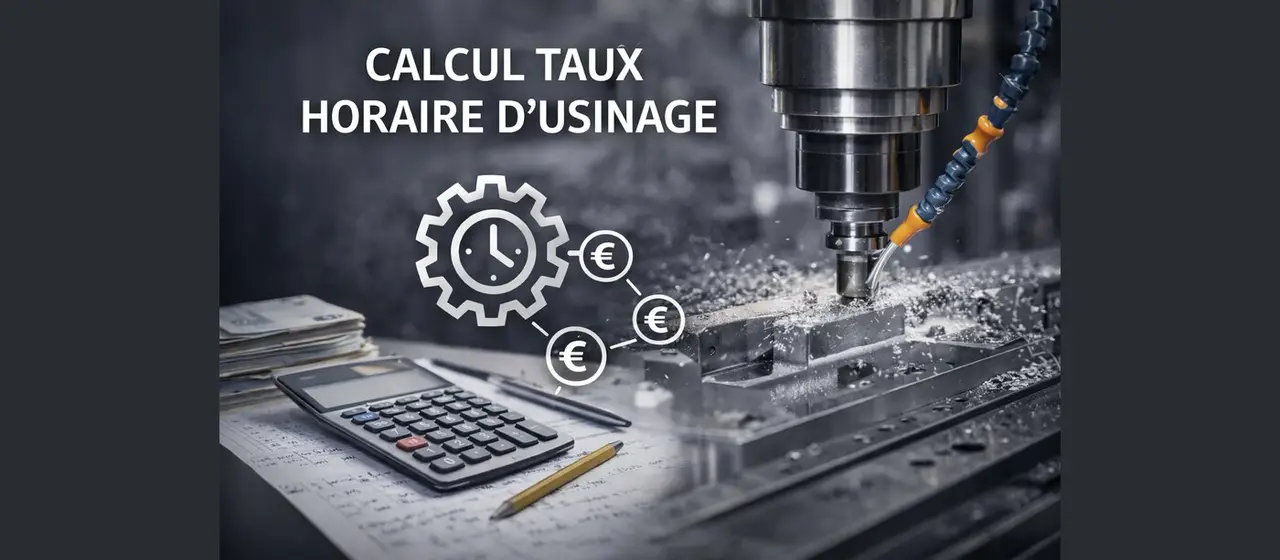
How much does an hour of production on your machining centre really cost you? Most workshops underestimate this cost by 15 to 30% because they overlook indirect depreciation, their share of rent, machine insurance or the operator's non-productive time. The direct consequence: quotes that are too low, collapsing margins, and profitability that never takes off despite a full order book.
The calculator below takes into account the four main cost families (depreciation, fixed costs, variable consumables, labour) to give you a true hourly rate. It updates the results in real time and displays a visual breakdown by item — you can see immediately where to act to improve your competitiveness.
Typical hourly costs in France (2026)
These ranges come from our field feedback from general engineering workshops, aerospace and medical subcontractors, and mould makers. Your figure may fall outside these ranges depending on your region, utilisation rate and overheads — that is normal. Use them as a competitiveness benchmark.
| Machine type | Hourly cost | Usage profile |
|---|---|---|
| Standard 3-axis machining centre V8-V11 | 45 – 65 €/h | General engineering, small batches, 400×400 parts. |
| High-performance 3-axis machining centre V13 / VP | 55 – 80 €/h | Hard materials, moulds, high-frequency spindles. |
| 5-axis machining centre A Series | 75 – 120 €/h | Aerospace, medical, complex parts in a single set-up. |
| Double-column DC | 80 – 130 €/h | Large parts, moulds, aerospace structures. |
| Horizontal centre + palletisation H | 70 – 100 €/h | Series production, optimised 24/7 utilisation. |
| 2-axis CNC lathe | 40 – 55 €/h | Turned parts, simple tailstock. |
The four formulas that calculate your hourly cost
Understanding the logic behind each cost item helps you identify your own levers for optimisation.
Hourly depreciation
For a €120,000 machine depreciated over 7 years with a 10% residual value and 1,600 productive hours: €9,64/h. Moving to 3,200 h (2×8) brings this cost down to €4,82/h — hence the huge benefit of high throughput.
Hourly fixed costs
These costs are incurred whether or not the machine is running. Even when it is idle, the floor space is rented and the insurance still applies. The best way to reduce them: increase utilisation.
Hourly variable costs
Tooling is often the most overlooked item: a €120 carbide cutter lasting 3 h accounts for €40/h on its own. Switching to an AlCrN-coated tool at €180 that lasts 8 h: €22,50/h. The coating pays for itself.
Hourly labour
The occupancy rate is the most powerful lever. Multi-machine supervision (2 to 4 centres) transforms your business model without further investment in equipment.
Three strategies to lower your hourly cost
Once you have established your real rate, three concrete approaches can reduce it significantly without compromising on quality.
Replacing an old machine: the calculation that changes everything
Many workshops keep fully depreciated machines in the belief that they are saving money. It is often the opposite. A 15-year-old machine typically generates:
- +30 to +50% more time per part (slower spindle, limited cutting feed rates, slow tool changes).
- Repeated breakdowns that eat into annual productive hours (falling from 1,600 h to 1,100 h is not unusual).
- Corrective maintenance at €4,000–8,000/year compared with €1,500–2,500 for a recent machine under contract.
- Wear parts that are impossible to find or have 6–8 week lead times from manufacturers that no longer exist.
If you replace an old machine, the productivity gains cover the investment within 2 to 3 years in most scenarios — and your hourly cost falls from the very first year thanks to the combined effect of productive hours × throughput.
Considering the purchase of a machining centre?
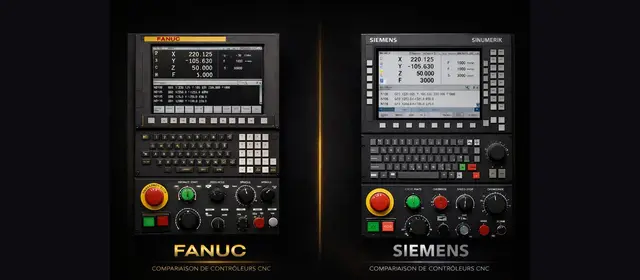
Our Baofeng machines offer one of the best performance-to-price ratios on the market: high-frequency spindles, Fanuc or Siemens controls, FC30 cast-iron frame, France-based after-sales service, 1-year manufacturer's warranty and spare parts stocked in Europe. Dozens of French workshops already use them in general engineering, moulds, aerospace and medical.
- Discover the full catalogue — V, VP, T, A, DC and H Series.
- Launch our configurator to find the right machine for your parts.
- Request a quote with a detailed profitability simulation: our team projects your future hourly cost and ROI from your real data.
- Explore our financing options (leasing, lease with purchase option, finance lease) to spread the investment.
- Find out all about our warranty and French after-sales service.