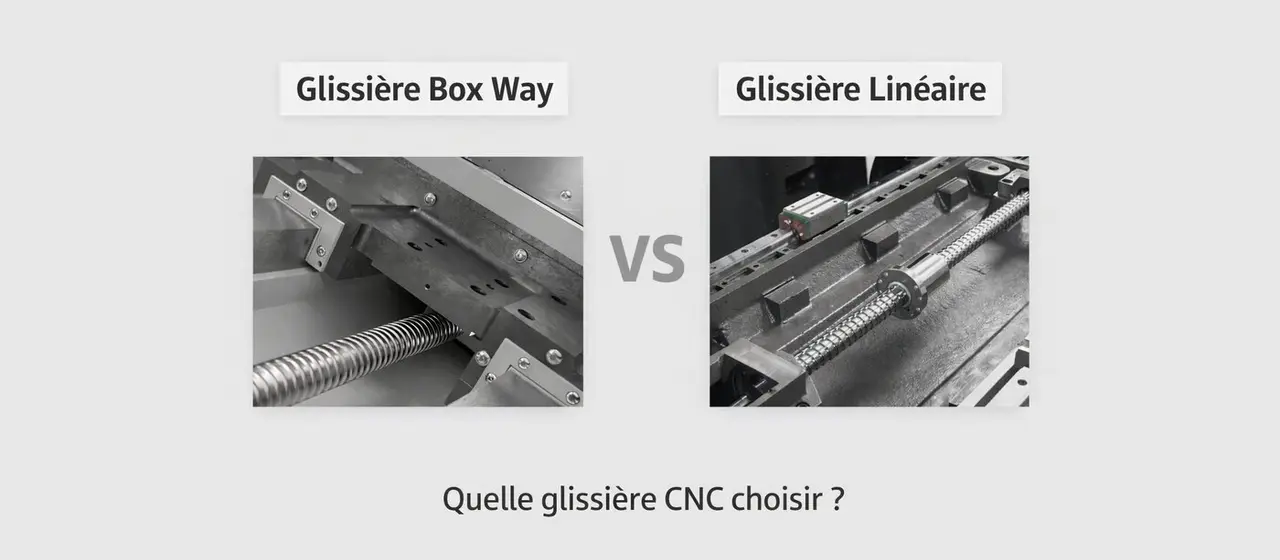
The type of guideway is the first key structural decision when buying a machining centre. It determines traverse speed, damping capacity and cutting rigidity and, ultimately, the materials and types of parts you can machine efficiently. Two technologies dominate the market: linear rail guideways and box-way guideways (slideways).
Linear guideways: speed and versatility
Linear guideways use recirculating ball or roller carriages mounted on ground rails (THK, Hiwin, Bosch Rexroth). It is the most widespread technology on modern machining centres.
Technical characteristics
- Rapid traverse: 36 to 48 m/min (versus 20-30 m/min for box-way)
- Acceleration: 0,8 to 1,2 G — shorter positioning times
- Positioning accuracy: ±0,005 mm (standard), ±0,003 mm (with optical scales)
- Friction: very low (coefficient ~0,01), enabling precise micro-movements
- Maintenance: automatic centralised lubrication, long service life if the machine is properly maintained
When should you choose linear guideways?
- Machining aluminium and light alloys (aerospace, automotive)
- Small, varied batches with frequent part changeovers
- Production requiring fast cycles and short positioning times
- High-speed finishing of moulds and dies (HSM)
- 3+2-axis or simultaneous 5-axis work
This is the technology used in our V Series, available from the compact V8 (800 × 500 mm) to the large-format V13 (1,300 × 700 mm), as well as in our 5-axis A Series.
Box-way guideways: rigidity and damping
Box-way guideways use Turcite-B-coated slideways (or equivalent) fitted by manual scraping. It is a proven technology, favoured for heavy-duty work.
Technical characteristics
- Vibration damping: 5 to 10× better than linear guideways thanks to the large contact surface
- Static rigidity: excellent — handles deep cuts without chatter
- Rapid traverse: 20 to 30 m/min (slower than linear)
- Durability: less sensitive to workshop conditions (dust, chips, temperature)
- Positioning accuracy: ±0,008 mm (standard) — sufficient for roughing and semi-finishing
When should you choose box-way?
- Machining hardened steel, cast iron, stainless steel, titanium — materials that generate significant vibration
- Heavy roughing with deep cuts and high feed rates
- Production of large moulds requiring perfect stability
- General engineering subcontractors working mainly in steel
- Environments demanding maximum mechanical robustness
This is the technology used in our VP Series — the VP in the name stands precisely for “Vertical Precision” with box-way guideways.
Head-to-head comparison
| Criterion | Linear guideways | Box-way guideways |
|---|---|---|
| Rapid traverse | 36 – 48 m/min | 20 – 30 m/min |
| Acceleration | 0,8 – 1,2 G | 0,3 – 0,5 G |
| Damping | Low | Excellent |
| Heavy-cutting rigidity | Good | Excellent |
| Positioning accuracy | ±0,005 mm | ±0,008 mm |
| Preferred materials | Aluminium, composites, plastics | Steel, cast iron, stainless steel, titanium |
| Cycle times | Shorter (rapid traverse) | Longer but stable |
| Surface finish | Excellent in HSM finishing | Excellent in heavy cutting |
| Baofeng series | V Series, A Series | VP Series |
Case study: general engineering subcontracting
A subcontracting workshop machining 70% steel and 30% aluminium is torn between a V11 (linear) and a 1166VP (box-way). Here is the analysis:
- With 70% steel, roughing vibration will be the limiting factor on linear guideways. You will have to reduce cut depths, which lengthens cycles.
- The 1166VP will better absorb cutting forces in steel, allowing more aggressive cuts and shorter overall cycle times despite a lower rapid traverse speed.
- For the 30% aluminium, the VP will be slightly slower in positioning, but the impact on total cycle time remains marginal.
Recommendation: for this profile, box-way is the right choice. Real-world productivity (parts/hour) will be better.
Case study: aerospace subcontractor
An aerospace workshop machining 90% 7075 aluminium with deep pockets and thin walls:
- Linear guideways are essential: high spindle speed (15,000+ rpm) and rapid movements for the many repositionings.
- For large parts, a DC Series double-column will combine linear guideways with structural rigidity.
Still undecided?
Use our online configurator: with 4 questions about your materials, volumes and requirements, it identifies the right models. Or call us — our technical advisers have installed hundreds of machines and know real-world applications first-hand.