Estimating machining time correctly is a key task in the workshop: it shapes your quotes, the capacity planning of your machines and any objective comparison between two machining centres. An estimate that is too optimistic loses you money on every part; one that is too cautious drives your customers to the competition. The calculator below gives you a reliable first approximation in seconds, based on the geometry of the area to be machined and the cutting parameters.
Total cycle time breaks down into three blocks: pure cutting time (tool engaged), rapid traverse time (non-cutting moves, approaches, returns) and tool changes. On a real job, non-productive time often accounts for 30 to 50 % of the cycle — hence the importance of high rapid traverse rates and, on horizontal machines, a pallet changer.
Typical cycle times by operation
Indicative values for a solid carbide end mill on a standard machine with a 10,000 rpm spindle and 36 m/min rapid traverse. To be refined according to your machining strategy and CAM.
| Operation | Material | Parameters | Cycle time |
|---|---|---|---|
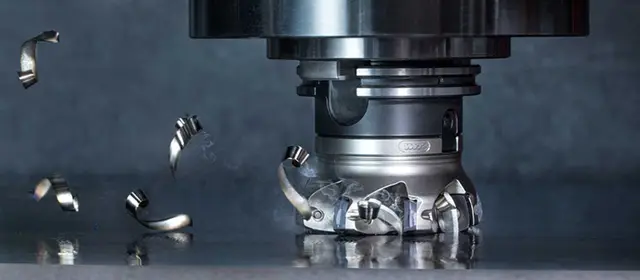
| Face milling 200 × 100 × 2 mm Milling | Aluminium | D50 — Vf 3,500 mm/min — ap 2 mm | ≈ 40 s |
| Face milling 200 × 100 × 2 mm Milling | Medium-hard steel | D50 — Vf 1,200 mm/min — ap 1 mm | ≈ 2 min 20 s |
| Pocket 100 × 50 × 20 mm Roughing | Aluminium | D12 — Vf 2,500 mm/min — ap 4 mm, ae 8 | ≈ 3 min 30 s |
| Pocket 100 × 50 × 20 mm Roughing | Medium-hard steel | D12 — Vf 800 mm/min — ap 2 mm, ae 6 | ≈ 14 min |
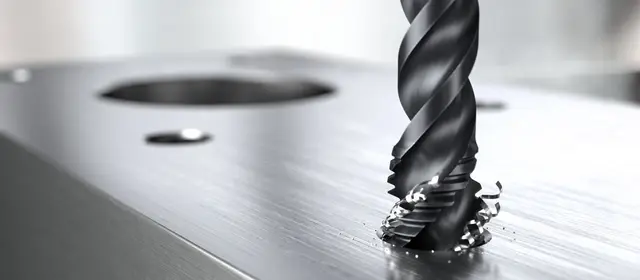
| Drilling 20 holes D8 mm Drilling | Aluminium — thk. 20 mm | N 4,000 rpm — Vf 500 mm/min | ≈ 1 min 10 s |
| Drilling 20 holes D8 mm Drilling | Medium-hard steel — thk. 20 mm | N 1,500 rpm — Vf 180 mm/min | ≈ 3 min 20 s |
| Tapping 20 holes M8 Rigid tapping | Aluminium | N 600 rpm — pitch 1,25 | ≈ 1 min 40 s |
| Tapping 20 holes M8 Rigid tapping | Medium-hard steel | N 300 rpm — pitch 1,25 | ≈ 3 min 20 s |
Machining time formulas
Three fundamental relationships let you estimate a cycle time from the geometry of the area and the cutting parameters.
Number of passes
Each depth pass (ap) and each lateral pass (ae) must be rounded up to the next whole number: a 10 mm deep pocket with ap = 3 mm requires 4 passes (3 + 3 + 3 + 1).
Cutting time
Time during which the tool is actually cutting. This is the "productive" part of the cycle — everything else should be minimised.
Estimated rapid traverse time
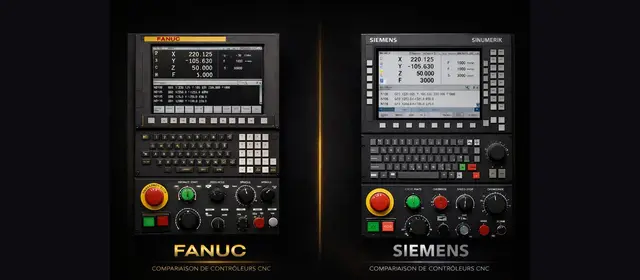
Rapid moves take longer than their theoretical distance alone suggests: accelerations, decelerations, slow approaches near the part. A coefficient of 0,3 gives a realistic estimate on a modern CNC control (Fanuc, Siemens).
Material removal rate Q
The volume removed per minute. Used to check that the spindle power is sufficient: in steel, allow roughly 0,3 kW per cm³/min. Above 100 cm³/min in steel, a spindle of ≥ 30 kW and a rigid machine (VP Series or horizontal) become necessary.
How to reduce your cycle times
Three levers can save 20 to 50% on a milling cycle, beyond simply optimising cutting parameters.
spindle
Trochoidal
palletisation
Rapid traverse: the underestimated factor
On a job with many small operations (drilling, short pockets, multiple passes), rapid moves account for up to 40% of the cycle. Doubling the rapid traverse rate does not halve this time — acceleration remains the limiting factor — but the real gain is substantial.
Our V Series centres offer 48 m/min rapid traverse on all three axes, compared with 24 m/min on a comparable entry-level machine. On a typical “plate with 400 D8 holes” job (positioning-intensive), we observe a cycle time gain of 15 to 20% in customer conditions with identical cutting parameters. Payback is measured in months, not years.
In series production, the combination of 48 m/min rapids + pallet changer + 40-position tool changer on our horizontal machining centres can halve the overall cycle time compared with a conventional vertical machine without pallets.
What next?
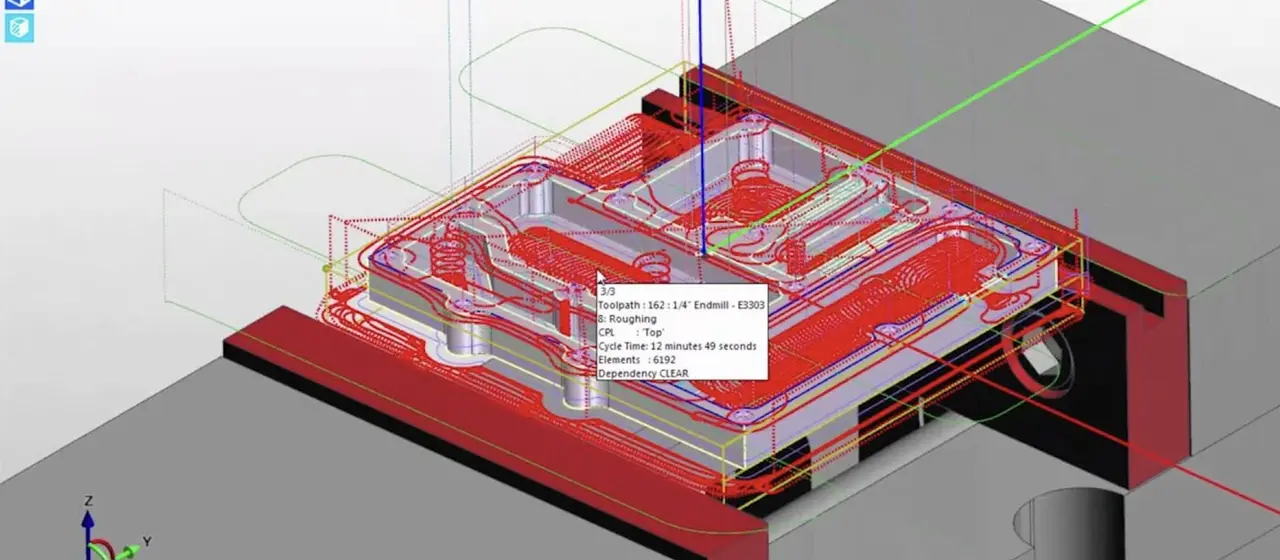
This calculator gives an estimate for a rectangular area machined with parallel passes. For complex cases (pockets with islands, 3D, 5-axis), only a CAM post-processor gives a reliable time — but the formula above remains an excellent safeguard for spotting anomalies in a program.
- V Series vertical machining centres — 48 m/min rapids, 8,000 to 15,000 rpm spindle, ideal for general engineering.
- T Series — optimised for high-speed drilling and tapping, fast 1.2 s ATC.
- Horizontal machining centres — pallet changer, uninterrupted series production.
- Online configurator — find the right machine for your production in 5 minutes.
A question about a specific cycle, a quote to validate, a machine choice to make? Our technical team will respond within 24 hours with a detailed estimate based on your actual parts.